ILÉM PAPER
Second Hand Nostalgia – A conversation with Uyghur Artist Camilla Dilshat
Non-belonging – A conversation with Conceptual Artist Intizor

The Girl Who Ran in Heels – On Distance, Identity, and Arriving Somewhere No One Expected You.
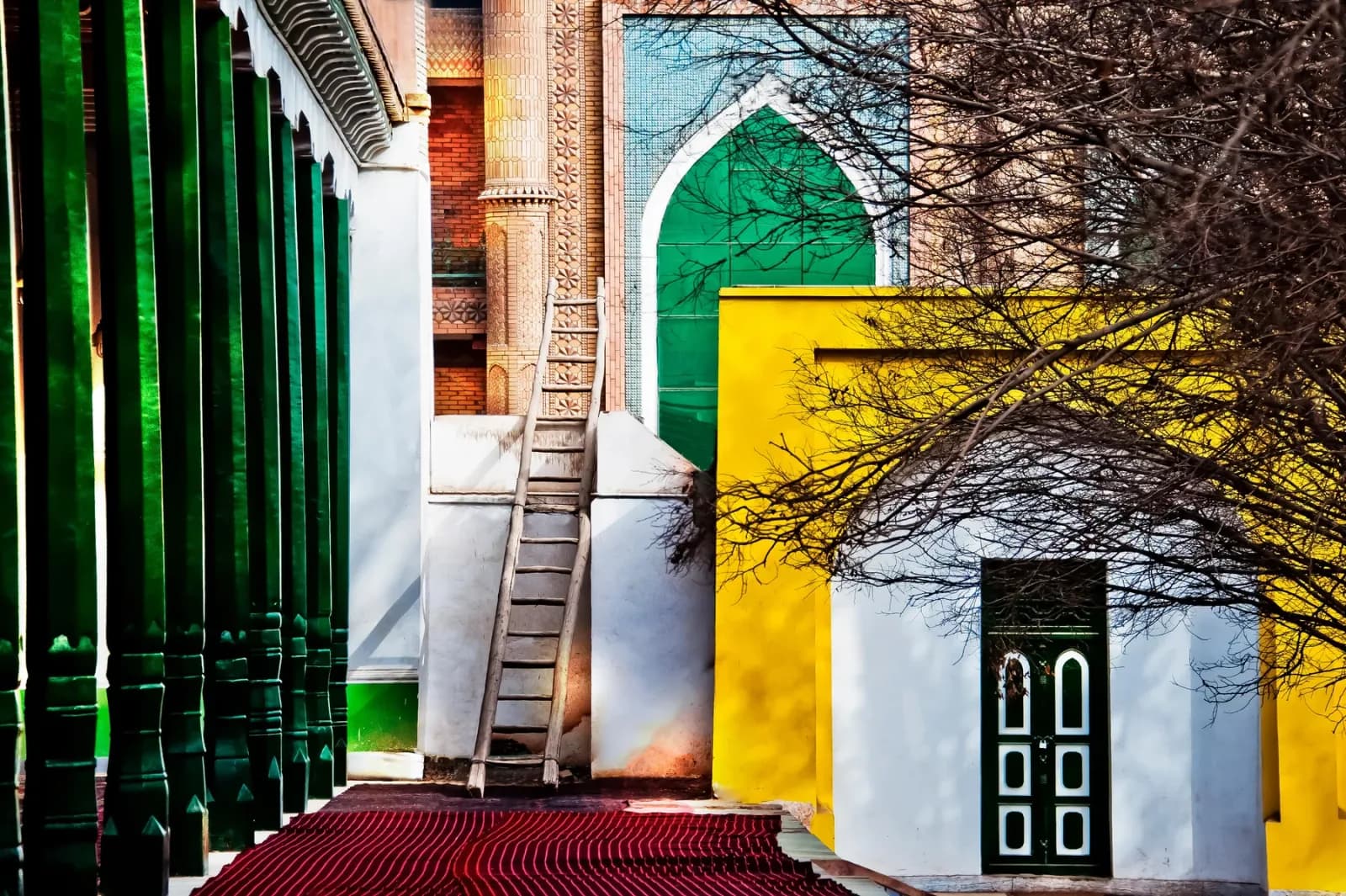
Visual complexities arise, in this Hotan rug
Non-belonging – A conversation with Conceptual Artist Intizor
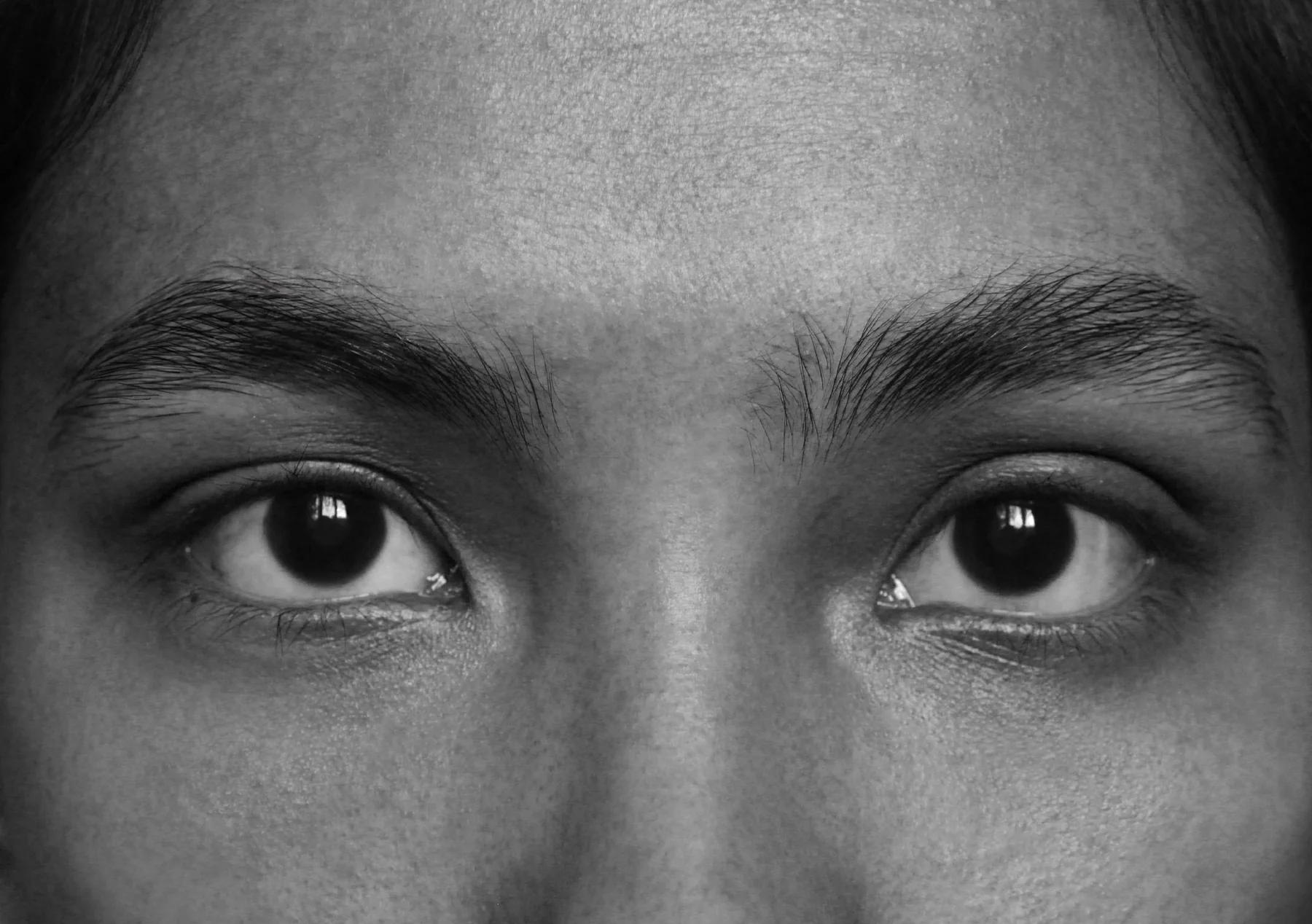
Some people you interview because their work fits the story you're telling. Intizor you interview because she makes you stop and think deeper.
She's a conceptual artist from Almaty — self-taught, Uyghur, someone who spent years sitting with the feeling of not belonging anywhere before she decided to turn it into a beautiful story. I think that kind of honesty has a way of cutting through.
Intizor doesn't belong anywhere. She'll tell you that herself.
-Imran
I.A. - How do you introduce yourself when someone asks what you do?
I. - I say I’m an artist—I do conceptual art. It often sounds too vague, so I add that I do everything except painting. But there are many exciting interweavings between video and drawing, so hopefully I’ll change my introduction in the near future.
I.A. - You work across film, performance, writing, and installation. Is there a thread that connects all of it for you?
I. - I’m self-taught, so I started with the mediums that were most accessible to me at the time. Now I listen to ideas—they tend to decide for themselves which form suits them best.
Of course, my experience and preferences influence that, which can feel limiting. Some projects exist only in a Google document, waiting for a more skilled version of me. Also, I’m very good at procrastinating.
I.A. - Tell me where you grew up, and how much that place—its textures, its silences, its particular light—still lives in your work.
I. - I was born in Tashkent, so my earliest memories are tied to that place. They’re quite faded, but they can hit me unexpectedly.
When I was six, we moved to Almaty, and I’ve been based there since. A place inevitably shapes you, but I resist labeling myself as “an Almaty girl” or anything like that. Labels lead too easily to stereotypes.
Almaty taught me to notice immediately when there are no mountains. That feeling may not be present in my work, but it definitely lives in my body.
I.A. - You’ve described yourself as someone who “doesn’t belong anywhere.” Has making art helped you make peace with that, or does the work keep reopening the question?
I. - Only last autumn did I fully accept my non-belonging—turned it into a fact, without any ache attached. It took years of reflection and several projects to arrive there.
Art is complicated. It gives me a lot, but it also takes more. Still, it’s my way of dealing with reality—how I process everything.
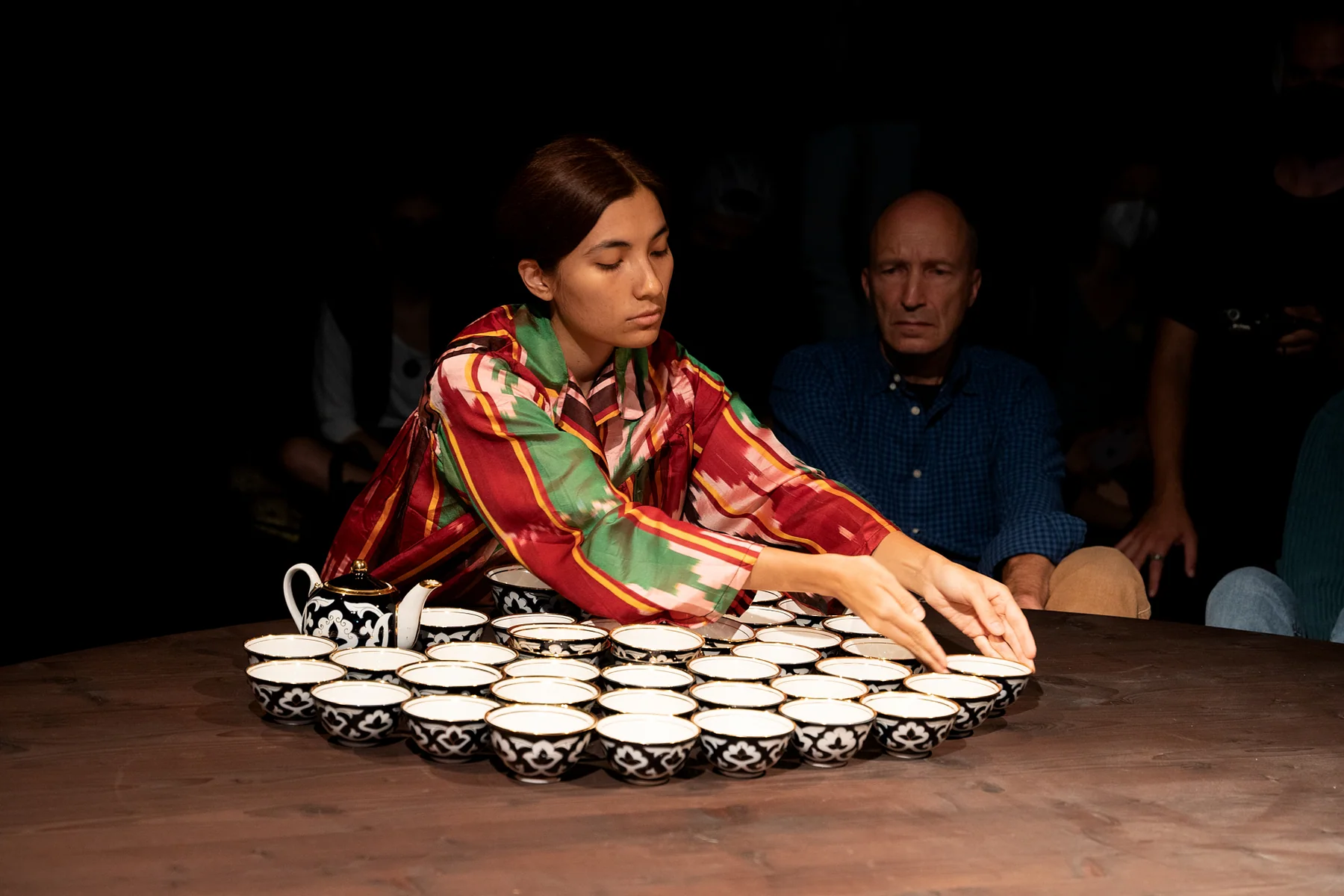
I.A. - For someone discovering your work for the first time, how would you describe Precious Drops?
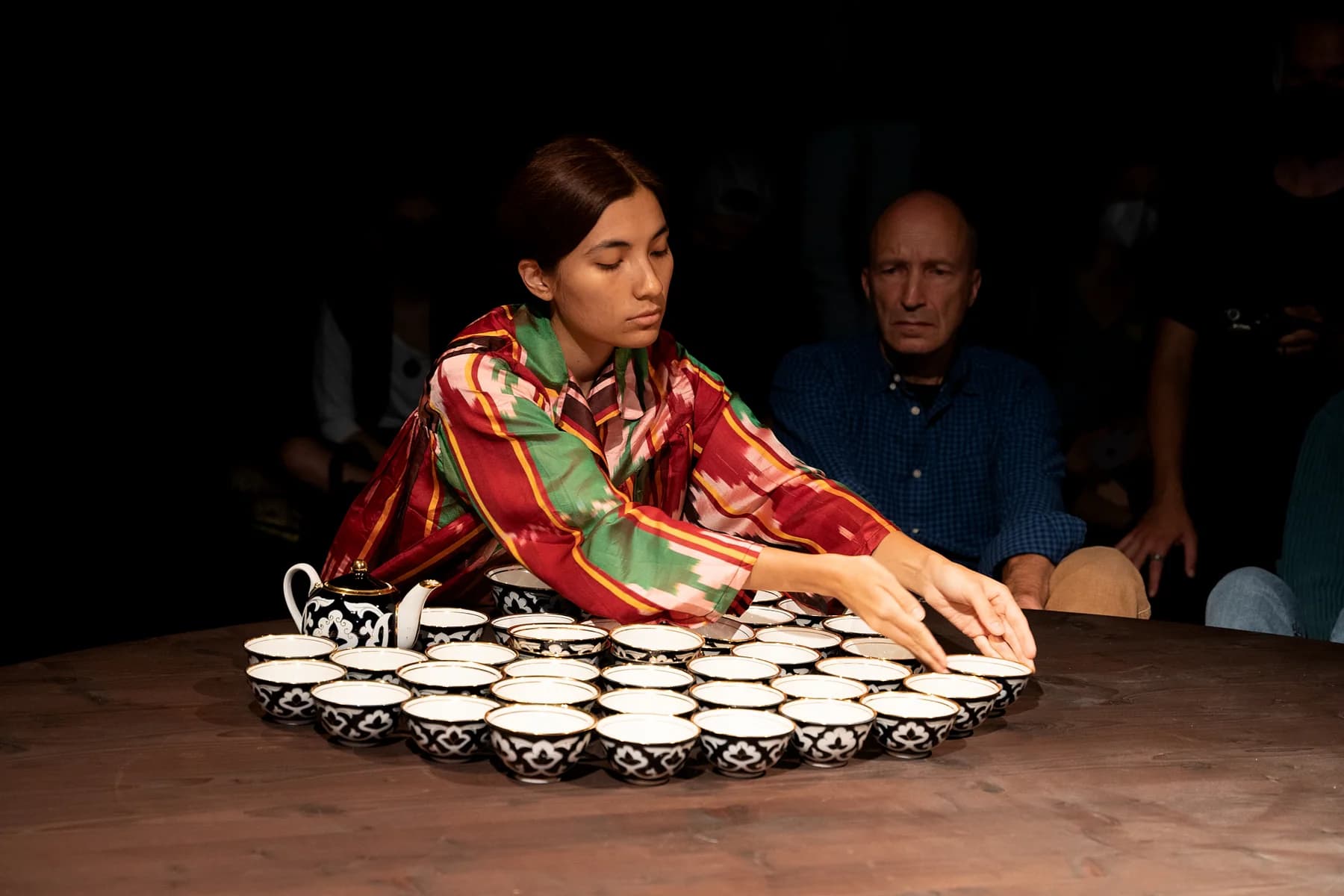
I. - Precious Drops is one of my first works exploring water—a subject that has drawn me in for a long time. Water is complex and deserves to be approached from many perspectives. In this performance, I focused on it through ritual.
I.A. - “Girls in Central Asia learn to pour tea before they learn almost anything else.” When you chose tea as the material, were you thinking about memory or experience?
I. - While thinking about water, I realized I mostly interact with it in the form of tea. That led me to think about food more broadly—something so central to daily life, yet deeply gendered.
I.A. - You were singing while the tea was being poured—the voice and the water happening simultaneously. What was moving through you in that moment?
I. - Saodat Ismailova and the Davra Collective invited me to participate in documenta fifteen, which I’m very grateful for. I both poured the tea and sang—at least, I tried.
Before that, there were many Zoom conversations with Saodat and the other participants. It was important to me to represent Uyghur culture beyond narratives of victimhood and genocide.
The phrase “spill the tea” connects voice and water in my mind. I sang in Uyghur—a language I don’t usually speak and chose not to fully learn—so it was emotionally difficult, but necessary.
I.A. - Precious Drops was performed at documenta fifteen, largely in front of a European audience. What did that experience feel like?
I. - It was my third or fourth exhibition, my first trip to Europe, and my first performance. After pouring the tea, I left the museum as quickly as I could—I don’t have the best social skills.
What I remember most is that all eyes were on me. It’s a very unique sensation.
I.A. - The act of serving tea is often framed as preparation for becoming a wife. Did you ever accept that idea growing up?
I. - There’s nothing wrong with tea or with being a wife—except for its connection to patriarchy, which I’ve always resisted.
I.A. - The ritual of chilla marks 40 days, and your performance used 40 cups. How did that number hold meaning for you?
I. - I’m not someone who thinks deeply about numbers. The 40 cups were mostly a reference to Saodat’s research, if I remember correctly.
But 40 appears everywhere in Central Asian culture—from birth to death. My favorite explanation is that it simply means “a lot.”
I.A. - You mentioned a residency—how has distance from Central Asia shifted your perspective creatively?
I. - I’ll be in Singapore later this year. Travel is always a way into new knowledge—distance allows me to zoom out.
Right now, I’m in residency in Nukus, near the Aral Sea, or what’s left of it. I’m curious how narratives around water shift depending on place.